
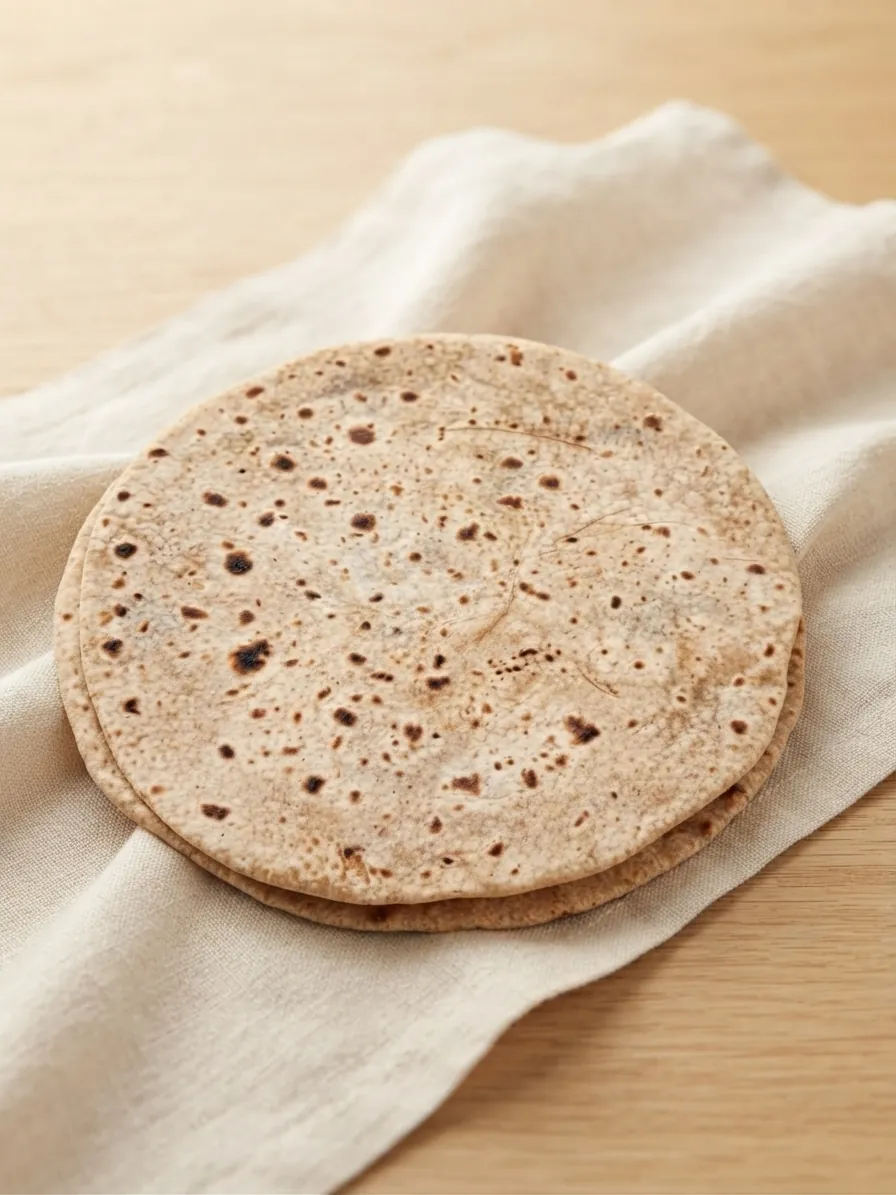
Every home cook in Maharashtra knows this disappointment. The chapatis come off the tawa soft and puffed, you stack them in the dabba, and by lunchtime they bend like cardboard. Some days they stay soft for hours, other days they turn stiff within thirty minutes. It feels random, but it isn’t. There is real food science behind it, and once you understand it, you can control it.
At Samarth Chapati House we cook chapatis every morning and every evening, so this question is not academic for us. A chapati that hardens before it reaches a customer’s plate is a failed chapati. Here is what we have learned about why rotis harden and what actually keeps them soft.
What a Chapati Is Really Made Of
A chapati has only four ingredients: wheat flour, water, a little oil and salt. But the flour itself is a mix of several components that behave very differently when they meet water and heat. Three of them matter most for softness.
1. Gluten: the stretch
Wheat contains two proteins, glutenin and gliadin. On their own they are just dry powder. When you add water and knead, they link together and form gluten, a stretchy network that traps steam. That trapped steam is what makes a chapati puff up on the flame. Glutenin gives the dough strength and elasticity, while gliadin makes it extensible so you can roll it thin without tearing.
Too little kneading and the gluten network stays weak, so the chapati tears and doesn’t puff. Too much kneading with too little rest and the dough fights back when you roll it, giving you a thick, chewy roti. Resting the dough for 15 to 20 minutes lets the gluten relax.
2. Starch: the softness, and the villain
Starch is the largest part of wheat flour, often around 70 percent of it. When you cook the chapati, the starch granules absorb water, swell and soften. This process is called gelatinisation, and it is what gives a hot chapati its tender, almost melting texture.
The problem starts when the chapati cools. As the temperature drops, the starch molecules slowly realign themselves into a tighter, more crystalline structure and push water out. Food scientists call this retrogradation. It is the same thing that makes bread go stale and leftover rice turn hard in the fridge. A hard chapati is not always a dry chapati; often the water is still there, but the starch has locked itself up.
3. Arabinoxylans: the quiet helpers
Wheat also contains natural fibres called arabinoxylans, sometimes called pentosans. They are present in small amounts, but they can hold several times their own weight in water. They help the dough keep moisture and affect how soft and moist the finished roti feels. Whole wheat atta, which keeps more of the bran, has more of these fibres than refined maida, which is one reason good chakki atta makes a softer, more flavourful chapati.
The Five Most Common Reasons Chapatis Turn Hard
When customers tell us their homemade rotis go stiff, the cause is usually one of these.
- The dough is too dry. A stiff dough has less water for the starch to absorb, so it retrogrades faster. Chapati dough should be soft enough that your finger leaves a gentle dent.
- The dough wasn’t rested. Unrested gluten makes you roll harder and thicker, and thick chapatis lose steam slowly and unevenly.
- Too much dry flour while rolling. The extra flour sticks to the surface, burns on the tawa and leaves a dry, papery coating.
- Cooking on low heat for too long. A slow tawa dries the chapati out before it can puff. A hot tawa cooks it fast and seals the moisture in.
- Leaving chapatis open to air. Hot rotis release steam. If that steam escapes into the room, the surface dries and hardens as it cools.
How We Keep Our Chapatis Soft
Most of what we do in our kitchen comes down to controlling the three components above.
We measure, we don’t guess. For every batch, flour, water, oil and salt go in at a fixed ratio. For example, in our tests a 3 kg batch of atta takes roughly 1.9 litres of water and around 90 ml of oil. The exact numbers shift a little with each flour lot, but measuring keeps the dough consistent day after day.
We weigh every dough ball. Each ball is weighed to 50 grams. Uniform balls roll into uniform chapatis that cook in the same time, so none come out over-dried.
We check the dough texture before dividing it. If the dough feels tight, it is corrected before a single chapati is rolled.
We control tawa temperature. Our tawas run hot, roughly in the 150 to 180 °C range depending on the stage, so each chapati cooks quickly and puffs well instead of drying slowly.
We pack them warm and covered. Chapatis are stacked while warm and wrapped so the steam stays inside the stack instead of escaping into the air. A little oil on the surface also slows moisture loss.
Tips You Can Use at Home
Quick checklist for softer rotis: soft dough, 15–20 minutes’ rest, light dusting of flour, hot tawa, and a covered casserole or cloth-lined box for storage.
- Use lukewarm water for kneading in winter. Cold water makes the dough tighten and the gluten slower to develop.
- Add a spoon of oil or ghee to the dough. Fat coats the starch and slows retrogradation.
- Some families add a little warm milk or curd to the dough. The extra fat and moisture make the roti softer, though it will not keep as long.
- Don’t rest the dough for hours in the fridge unless you bring it back to room temperature before rolling.
- Stack and wrap immediately. A clean cotton cloth inside a steel dabba or casserole works better than an open plate.
- Reheat with steam, not dry heat. Sprinkle a few drops of water and warm the chapati on a tawa for a few seconds, or steam the stack in a covered pan. Moist heat reverses some of the starch hardening.
Why the Fridge Makes It Worse
This surprises many people. Storing chapatis in the refrigerator actually speeds up retrogradation, because starch crystallises fastest at cool temperatures just above freezing. If you must keep chapatis for the next day, wrap them tightly and reheat them with steam. For longer storage, freezing is better than refrigerating, because freezing slows the process almost to a stop.
The Bottom Line
A soft chapati is not luck. It is the result of good flour, a well-hydrated and rested dough, even rolling, a hot tawa and careful storage. Starch will always try to harden as it cools; your job is to slow it down. That is exactly what we focus on, batch after batch, in our Nashik kitchen.
If you would rather skip the kneading and rolling altogether, we are happy to do it for you. Our chapatis are made fresh twice a day and delivered warm across Nashik.
Fresh rotis, delivered in Nashik
Chapati, bhakri, nagli roti and puran poli made fresh twice a day. Order on WhatsApp at 7498630507.